Search This Blog

Monday, October 26, 2015

Rewarding the Rogue Regime


http://councilforstrategicaffairs.blogspot.com/2015/10/rewarding-rogue-regime.html

The cat is finally out of the bag! As a very much diminished Pakistani PM Nawaz Sharif  arrived for a much truncated  summit with Barack Obama on October 22nd, initial Pakistani denials about a civil nuclear deal gave way to admission that Pakistan has already developed India-centric tactical nuclear weapons. The US side was more frank in admitting that a civil nuclear deal was being discussed with Pakistan for last few months but it will not be signed during the current visit owing to lack of agreement.
Initial US postures:
The first inkling about any possible civil nuclear deal between Pakistan and the US was a beautifully staged interview of General Khalid Kidwai, the former director of Pakistan’s Strategic Planning division. The interview was done during Carnegie Endowment for International Peace’s Biennial Nuclear Policy Conference in March 2015. Peter Lavoy, a foremost Pakistan expert threw softballs at General Khalid Kidwai who took a very anti-India aggressive posture in the presence of still practicing Nuclear Non-Proliferation Ayatollahs of the American think tanks in Washington, DC. General Kidwai got away with regurgitating stark lies about the so-called “Cold Start Doctrine” of Indian Army and half-truths about India’s nuclear posture.
This was followed in August 2015 by a 48 page long joint report by Carnegie Endowment and Stimson Center authored by Toby Dalton and Michael Krepon. Titled a “Normal Nuclear Pakistan”, it advocated putting four brackets on Pakistani nuclear program in exchange for some concessions by the US and a carrot of the NSG membership and other international regimes. The report exhorted mainstreaming of Pakistan’s nuclear program if it agreed to sign and ratify the CTBT without waiting for India, agreed to limit production of fissile material and stop blocking FMCT, agreed to separate civil and military nuclear programs and agreed for limits in production of short range missiles and tactical nuclear weapons. In essence the report exhorted Pakistan to implement a paradigm shift back to “Credible Minimum Deterrence” from the “Full Spectrum Deterrence” in exchange for mainstreaming!
US Debate:
This was followed by selective disclosures and pleadings from former CIA officers like Kevin Hulbert and journalists including David Ignatius and David Sanger. Characterizing Pakistan as “Too big to fail”, Kevin Hulbert emphasized the nuclear threat posed by Pakistan.  Labeling Pakistan as probably the most dangerous country for the world, he enunciated his case for more nuclear engagement with Pakistan as that country poses triple threats of terrorism, failing economy and the fastest growing nuclear arsenal. David Ignatius, the Washington Post columnist disclosed the ongoing exploratory discussions of civil nuclear deal with Pakistan on October 6th 2015. Ignatius reported that Pakistan has been asked to consider accepting “brackets” on its nuclear program and delivery systems without weakening the Pakistani nuclear deterrence towards India! David Sanger in his October 15th piece clarified that Pakistan is not being offered the civil nuclear deal similar to India. He reported that US is trying to explore ways to relax NSG rules for Pakistan with a long-term goal of allowing it to join the NSG. Apparently China’s flagrant violation of the NSG rules and nuclear commerce and proliferation with Pakistan is the reason necessitating relaxation of rules. Essentially, US bureaucracy is searching for a fig-leaf to hide its shame in not being able to control the nuclear proliferation activities of China and Pakistan! US is too weak economically and militarily to confront China & Pakistan for both vertical and horizontal nuclear proliferation activities as part of the CHIPNOKISS network.
A lively debate has ensued in the US about inadvisability of the WH initiative of rewarding this rogue state. US think tanks have taken pro-Pakistani positions while politicians oppose it. Lisa Curtis a respected analyst has urged not rewarding the rogue state. George Perkovich, the vice-President for Carnegie Endowment used the sales pitch that “If Pakistan would take the actions requested by the US, it would essentially amount to recognition of its rehabilitation and would essentially amount to parole”. The phrase “rehabilitation and parole” used by Perkovich angered the Pakistani establishment.
Congressman Ted Poe, who is Chairman of the Subcommittee on Terrorism, Non-proliferation and Trade, in a strongly worded letter to Obama urged the POTUS to not engage in any negotiations regarding a US-Pak civilian nuclear agreement because "Pakistan has repeatedly proven itself to be deceptive and deceitful!"
Daniel Markey, a senior research Professor at the John Hopkins SAIS and Adjunct Senior Fellow at the CFR summarized his crisp opinion by stating that “there is simply no time for nuclear deal” because Pakistan’s current condition raises other fundamental questions about its long-term relationship with the US. Pakistan’s nuclear arsenal continues to pose serious threats like insider theft, onward proliferation, accidents, sabotage or unauthorized use by rogue Jihadi officers!
Senator John Cornyn, Senate Majority Whip for the 114th Congress, said "it is ill-advised" to pursue any type of civil nuclear agreement with Pakistan. Senator Cornyn,   founder and Co-Chair of Senate India Caucus, reminded that the issues surrounding Pakistan's growing nuclear arsenal are of significant concern, and serious doubts persist regarding the security of its nuclear weapons. He also focused on Pakistan government’s clandestine nuclear proliferation network that provided nuclear weapons technology to rogue regimes in Iran, North Korea, and Libya. Cornyn’s reminder about this illegal network that has been dubbed as Nuclear Walmart or the CHINOKISS network is indeed a very timely reality check.
Pakistani Postures:
The initial inkling of any possible US-Pakistan nuclear deal came from Saira Bano, a Pakistani visiting fellow at the Stimson Center on June 22nd 2015. She disclosed that Pakistan had again demanded an India-style civil nuclear agreement under the auspices of the US-Pakistan dialogue during the 7th round of the US-Pakistan Security, Strategic Stability and non-Proliferation Working Group in June 2015. Advising Pakistan that the road to civilian nuclear cooperation begins in Islamabad, she exhorted Pakistani government to emulate India by focusing on economic growth and increasing trade relations in order to minimize the political temperature. Creating a soft international image of Pakistan with responsible behavior was her mantra for Pak establishment.
Following the disclosure from the White House, the ostensible Pakistani response was a vehement denial coupled with assertions that Pakistan will never accept any “brackets” on its nuclear and delivery system program.  Pakistan is focusing on IRBMs and nuclear-powered submarines supplied by China for second strike capability.
 Munir Akram, the disgraced former Pakistani Permanent Representative to the UN gave the initial defiant response that Pakistan will not negotiate its nuclear assets and will not accept any brackets in view of it doctrine of “Full Spectrum Deterrence”. This was followed by a frank admission by Foreign Secretary Aizaz Chaudhry that Pakistan has developed tactical nuclear weapons that are primarily India-Centric. Appointment of recently retired General Nasser Khan Janjua as the new national security advisor is indicative of the fact that General Raheel Sharif wants to negotiate directly with the WH without the constraints of dealing with the civilian administration of Nawaz Sharif.
Shahzad Choudhry, a retired Pakistani air-marshall acknowledged that the suicidal threats of “Full Spectrum Deterrence” should be the leitmotif for a dance drama by Nawaz Sharif before Obama. He opened the window for Pakistan to bite the bullet and reverse back to doctrinal shift to credible minimum deterrence. It is again rationalization of nuclear blackmail by the rogue state with a gun pointing at one’s own head. Following the good cop, bad cop tactic, Dr. Zafar Nawaz Jaspal, director, School of Politics and International Relations at the Quaid-e-Azam University characterized the reported offer of waiver for Pakistan for admission into NSG as “lollipops”. While Pakistan wants to be member of all the export control regimes, it is not willing to accept restrictions on its nuclear weapons program. Zahir Kazmi of the Strategic Vision Institute of Pakistan dubbed these expectations of Pakistan agreeing to “brackets” as wishful thinking! He opines that Pakistan should reject any such deal because the cost of “mainstreaming” is too high in terms of accepting conditions. Dr. Zafar Iqbal Cheema, the president of Strategic Vision Institute demanded parity and hyphenation with India in accepting any nuclear deal. Dr. Cheema rejected demands for reversion from “Full Spectrum Deterrence” back to “Credible Minimum Deterrence”.
Indian Response:
While the Government of India has remained very restrained and measured about any possible nuclear deal between US and Pakistan, the hyperactive Indian press and analysts have discussed it threadbare. The Ministry of External Affairs responded in the following words: “We’ve seen these reports and it is not for the first time this issue has surfaced. Whosoever is examining that particular dossier should be well-aware of Pakistan’s track record in the area of proliferation. When India got this particular deal it was on the basis of our own impeccable non-proliferation track record. That is the reason the U.S. gave us 123 Agreement in 2005 and that is why we got a NSG waiver in 2008. Pakistan’s track record is completely different, so we hope that will be taken into account in making any such decision”.
Happymon Jacob who teaches Disarmament and National Security at the School of International Studies, Jawaharlal Nehru University, New Delhi.in his op-ed piece in the Hindu takes the pro-US views about “Mainstreaming Pakistan” and wants New Delhi to offer conditional support to Pakistan’s inclusion in the global nuclear order. He enthusiastically wants the U.S. and other stakeholders to press Islamabad to stop stalling the FMCT negotiations, and agree to a nuclear ‘No-first-use’ agreement with India, which is already part of the Indian doctrine. He advocates obtaining firm commitments from Pakistan on clamping down on terrorism in the country in order to reduce the likelihood of nuclear terrorism in the region. He suggests re-hyphenation of India with Pakistan, as part of the deal, and to negotiate nuclear confidence building measures (CBMs) with that country. What he totally forgets is that any commitment by Pakistan in the past have been worth the used toilet paper! Pakistan’s strategic behavior does not change with engagement strategies. C Mohan Raja another pro-US analyst cogently highlighted the inherent contradictions in the proposed deal that make it very difficult to sell to both US and Pakistan.
Seema Sirohi, a Washington based journalist analyzed the behaviors and motives of the US actors behind the sudden blockbuster proposal and characterized the proposal as part revenge and part grandstanding. Peter Lavoy, the point person for South Asia in the US National Security Council is the chief architect of this blockbuster plan has deep links to Pakistani army. She further highlights that the joint think tank report states that India should not be allowed to join the NSG before Pakistan thus re-hyphenating India with Pakistan. The US deep state still romanticizes the Pakistani allies of the cold war era and are pining for the return of the intimate relationship.
Kanwal Sibal, a former foreign secretary, in a very detailed analysis explicitly states that US-Pakistan nuclear deal will be a threat to India’s security. Noting the historical US soft spot of Pakistan, the China Pakistan Nuclear Axis the proposed deal, he argues  would be a reward for Pakistani military as the nuclear program is under control of military without any civilian input.
The most cogent analysis was done by Dhruva Jaishankar, who has inherited Indian strategic genes. He bluntly described America’s Pak-Af policy as the definition of insanity! The real reason for Pakistan’s nuclear expansion isn’t India — it is for blackmailing the US to collect more rent. He argues that the US has been so fearful of Pakistan’s nukes being sold, stolen, lost, sabotaged, or accidentally used that during George W. Bush’s administration, $100 million was spent trying to secure the Pakistani nuclear arsenal. Since 2001, the Pakistan Army has also received more than $20 billion in military support from the US, even though it has continued to support terrorist groups like the Haqqani network that have killed hundreds of Americans. US has been gullible to trust successive Pakistani rulers who have adroitly shook down the superpower without US realizing that it has been conned! Rakesh Sood, India’s former representative at the Conference on Disarmament highlighted the shortcomings of previous US administrations when Reagan deliberately overlooked Pakistan’s clandestine nuclear activities. Pakistan’s obsession of nuclear parity with India encourages the US non-proliferation lobby to attempt re-hyphenation of India and Pakistan thereby rewarding that rogue nation.
The US-Pak Joint Statement:
While the US-Pakistan joint statement released on October 22nd is silent about any possible civil nuclear deal mainstreaming Pakistan immediately, it does comment on strategic stability, nuclear security, and nonproliferation. Using banal Diplomatese jargon the statement is high on rhetoric and low on content. Advising maximum restraint the statement exhorted Pakistan to work toward strengthening strategic stability in South Asia. The statement acknowledged the importance of regional balance and stability in South Asia. The joint statement highlights the continuing threat of nuclear terrorism and the need for Pakistan to work with US on Nuclear Security Summit.  The joint statement noted Pakistan's efforts and aspirations to improve its strategic trade controls and enhance its engagement with multilateral export control regimes. Recognizing the importance of bilateral engagement in the Security, Strategic Stability and Non-Proliferation Working Group, the joint statement hinted that both sides will continue to negotiate on a future “mainstreaming deal”.
The Aftermath:
Post the summit, Nawaz Sharif gave the ultimatum to the US to take Pakistan's side in its long-standing dispute with India or run the risk of escalating nuclear conflict. He stated that Pakistan was ready to help US and Afghanistan revive peace talks with Taliban rebels. Seeking a quid pro quo he made it clear that his main priority was seeking international support to compel India to negotiate over the future of Jammu & Kashmir.
The US, on the other hand, has categorically ruled out any kind of negotiations with Pakistan on India-type civil nuclear deal (123 Agreement), nor are they seeking country specific waiver for Pakistan from the NSG. The US insists that they have ongoing discussion on Pakistan’s nuclear safety and security along with promotion of strategic stability. What is not ruled out is a future deal that Pakistan may choose in near future if it does not insist on nuclear parity with India.
Gazing the Crystal ball:
Pakistani politicians and military take pride in brandishing their nukes at drop of a hat. Sartaj Aziz, the outgoing NSA of Pakistan boasted recently: “We are a nuclear armed country and we know how to defend ourselves”. From an Indian perspective, any civil nuclear deal between US and Pakistan would be strategically dangerous because it will further embolden the GHQ/ISI/Jihadi/Wahabi terror complex in Islamabad in staging acts of terrorism utilizing the services of non-state actors against India. It will be perceived as endorsement of Pakistan’s anti-India postures by the rogue military elite of that country.  Having said that, how much India would be able to influence the POTUS remains very questionable because in the 1980s Reagan administration brushed aside India’s concerns.
WWOD (What Would Obama Do)?
Obama’s legacy factor may trump all the rationale courses of action for the US. Obama is now a lame duck President hobbled by a dysfunctional Republican Congress who is looking for his foreign policy legacy. Despite his domestic failures, he has already made history by starting reengagement with Cuba and signing of a nuclear deal with Iran. However, he has proven ineffective and mediocre while dealing with the strategic chaos in Iraq, Libya, Syria, Yemen and in ending Pak-Af terrorism challenges. His administration is trying to offer a candy to Pakistan to cajole it to cooperate with the US’s and Obama’s deeply flawed Pak-AF strategy. Following into the footsteps of George W Bush, Obama regime has offered 8 new F-16 fighter planes to Pakistan ostensibly to deal with the insurgency in Balochistan besides the 70 F-16’s that Pakistan already has. Whom is Obama administration trying to fool?
There is limited time window of only 14 months between now and January 2017 when a newly elected US President will take office. Obama’s lame duck regime is likely to go on a fast track to finalize a nuclear deal with Pakistan at the cost of India in order to glorify Obama presidency for the posterity! Although negotiations for such a deal takes months and years, both parties are eager to win the trophy before January 2017. The US think tanks have an incestuous relationship with Pakistan from the cold-war era. They are, indeed, cheering for Pakistan and egging on the Obama administration to reward the rogue nation.
Pakistan may reluctantly consider signing the nuclear deal with “brackets” having no intention of sticking to the limits or caps or brackets. Reneging agreements and treaties  has been the persistent behavior pattern of the Pakistani state. A future POTUS may disregard Pakistani nuclear indiscretions reflexively in “larger US strategic interests” as Reagan had done in the past. In this regard it is important to review Pakistan’s past performance. Hussain Haqqani, the former Pakistani Ambassador to US and currently the Director for South and Central Asia at the Hudson Institute makes a candid confession that US policies have aggravated Pakistan’s dysfunction; reignited and reinforced the magnificent delusions that the US cannot simply manage the world without Pakistani help. He makes a point that Pakistan acquired nuclear weapons while promising the US it won’t go nuclear if it gets US economic and military assistance in 1970s and 1980s.
Internally, because of the deep divisions in the US policy establishment, this issue may get dragged into the presidential electoral politics. Obama and his acolytes forget that any legitimization of Pakistan would embolden Saudi Arabia and other gulf monarchies to develop their own military nuclear programs. Since Saudi Arabia has been the paymaster for the Pakistani nuclear program, post-deal Pakistan will indulge in nuclear commerce again albeit legally instead of through clandestine CHIPNOKISS network. Furthermore, Pakistan is not a normal state. It is an artificially contrived transitional entity which has been facetiously dubbed as an ideological Islamic Army with a country. Nothing else is farther from the truth than this blunt statement. There are major ideological similarities between the Daesh/ISIS/ISIL/The Islamic state and the GHQ/ISI/Jihadi complex of Islamabad. In both cases, an ideologically driven fighting force is holding civilians to ransom in the land they control. Welfare of the citizens is not the concern. Retired Pakistani military officers and nuclear scientists in past have volunteered their services to Al Qaeda. Leakage, theft, diversion and sabotage will remain serious limitations of Pakistani nuclear arsenal even if gets “mainstreamed”!
The current Republican party dominated US Congress may not approve any civil nuclear deal (123 Agreement) with Pakistan because of Pakistan’s consistently stellar record of duplicity and cheating forever on bilateral and multilateral agreements. America’s India-bashing cold-warriors who serve as the high priests and Ayatollahs of the US non-proliferation industry will make a last-ditch effort to reward the rogue state of Pakistan in order to further humiliate India for strategic autonomy and for her principled stand on NPT and CTBT. India must watch out for her strategic interests.
अपि स्वर्णमयी लङ्का न मे लक्ष्मण रोचते जननी जन्मभूमिश्च स्वर्गादपि गरीयसी

DR. ADITYANJEE
PRESIDENT,
THE COUNCIL FOR STRATEGIC AFFAIRS, NEW DELHI
adityancsa@gmail.com
twitter@DrThinkTank

Sunday, October 25, 2015

China's Ocean Hegemony and Implications for India

http://councilforstrategicaffairs.blogspot.com/2015/10/chinas-ocean-hegemony-and-implications.html


The fifth generation of CCP leadership under Xi Jinping has de facto abandoned the Deng doctrine of keeping low profile internationally. China has become more ambitious of becoming a superpower and has been extending its sovereignty claims on the land and the sea. As a rising hegemon, China has started to challenge the existing international strategic order. China has been in the news recently for building artificial islands with air-landing strips in the South China Sea. It has demanded 12 nautical miles exclusive economic zone around these artificial, man-made reefs. China is a signatory to the law of the Seas (UNCLOS). Chinese attempts to claim the bulk of the South China Sea goes against both the letter and the spirit of the law of the sea. Beijing will invoke its EEZ for its own economic benefits while denying the same rights to other claimants. Brushing aside the ASEAN Code of Conduct in the SCS, China claims sovereignty over all of the SCS which is disputed by Vietnam, the Philippines, Malaysia, Brunei and Taiwan.

For the last several years, Chinese official media has been harping on safeguarding China’s “Ocean Sovereignty”. The PLA navy’s goal is to have a “Thousand Ships Navy”. This stated “TSN” Goal is to further Chinese supremacy in the Indo-Pacific region and exploit the mineral & hydrocarbon wealth in the international sea-beds. PLAN has been entrusted to fight future wars for China’s security as per the former President Hu Jintao. On December 6th 2011, while addressing the PLA Navy, Hu Jintao pronounced that PLAN should make “extended preparations for warfare in order to make greater contributions to safeguard national security”. China unilaterally declared an air-defense identification zone in the East China Sea in November 2013. Recently, a Chinese admiral declared similar intentions of setting up an air defense identification zone in the future above the disputed areas of the South China Sea if Beijing thought it was facing a strategic threat.

China has created not only facts on the ground but also facts on the Ocean in a very predictable manner of claiming sovereignty with the “Chinese Characteristics”. China always makes maximalist claims against other countries, disputes sovereignty, and alters the facts on the grounds of medieval history or economic reasons, bullies the smaller adversaries into submission, demands mutual concessions while later on sending its armed forces. China has constructed a couple of lighthouses in the South China Sea to provide a fig-leaf for its naked hegemony and sea-resources grabbing activities. China has successfully converted the South China Sea into a virtual private lake affecting the freedom of navigation for the entire world. India has vital maritime interests in the South China Sea. 55% of Indian maritime trade passes through the South China Sea. China has objected vehemently to ONGC’s oil drilling in collaboration with Vietnam in the South China Sea and PLAN ships have started to harass the Indian drilling rigs.


 Once the heat of the South China Sea is gone and Beijing has de facto acquired the marine resources of the South China Sea, the dragon will spread its strategic tentacles into the Indian Ocean. Warning bells are already ringing in the Indian Ocean. PLAN started its naval forays in Indian Ocean up to the Gulf of Aden in 2010 under the garb of anti-piracy operations to control Somali pirates. China’s string of pearl initiative got absorbed in the 21st Century Maritime Silk Road. China did acquire significant naval facilities in Hambantota, Chittagong, Maldives, and listening & communication facilities in the Coco Islands in Myanmar besides building the naval port in Gwadar. Incidentally, India has gifted the Coco islands to Myanmar in Nehru’s realm. Gwadar port was offered to India by Oman but Nehru declined and Pakistan became the owner and the beneficiary. China also acquired naval facilities for recuperation and re-fueling in Seychelles in December 2011. China has already signed an agreement with the UN backed International Seabed Authority to gain exclusive rights to explore poly-metallic sulfide ore deposits in 10,000 square-kilometers of international seabed in Indian Ocean for 15 years. China has been sending nuclear powered submarines to Sri Lanka and Pakistan. Pakistan will receive eight Chinese nuclear powered submarines effectively neutralizing the Indian second strike capabilities in case of a nuclear attack on India.  China plans to buy an island from the Maldives for $ 1 billion under the current Maldivian Government of President Abdulla Yameen.

China’s response to Malabar naval exercises in 2007 when trilateral format included Japan was very negative leading to non-invitation to Japan later on after 2007. India plans to invite Japan in the upcoming Malabar exercises and Chinese reaction would be worth watching. China remains very paranoid about the US “Pivot to Asia” doctrine. Chinese paranoia about the Asian Quadrilateral led to Australia pulling out of that mechanism for maritime cooperation in the Indo-Pacific.

 China had sent trial balloons to US for a G2 condominium by which US will take over the Atlantic Ocean whereas China will have rights over the Pacific Ocean. Unlike Tibet, Indo-Pacific is too important to be given to China on a platter. As a trading nation with vital economic and maritime interests, India will have to safeguard the sea-lanes of communication, ensure freedom of navigation and take the strategic ownership of her maritime interests.


China’s foreign exchange reserves were at the peak of almost $4 trillion in June 2014. Despite a recent decline in Chinese economy, China’s foreign exchange reserves totaled $3.514 trillion at the end of September 2015. China still has the largest foreign exchange reserves in the world.  China will continue to extend its strategic footprints under the much enlarged One Belt, One Road (OBOR) project because it has plenty of spare cash. China also proposes to use the Beijing sponsored AIIB as the financing arm for the OBOR which will ultimately require $ 1.4 trillion in investments. China has already sanctioned $46 billion on China-Pakistan Economic corridor as part of the OBOR connectivity without taking India’s sensitivities about CPEC passing through the POK. While India has cooperated with China in the BCIM (Bangladesh, China, India, and Myanmar) Corridor project, the GOI has been deliberately silent about any synergistic cooperation with the 21st Century Maritime Silk Road project.

In contrast to China, India’s foreign exchange reserves were only $352 billion in September 2015. Despite willing to take remedial action, New Delhi does not have the hard cash to take upon Chinese naval strategic threat in Indian Ocean. The strategic asymmetry vis-à-vis China will require some cool-headed long-term strategic and economic planning. Diplomats like Shyam Saran have rightly advocated limited but pragmatic cooperation with China on the OBOR while shoring up our own connectivity projects including the Chabahar port in Iran and Andaman and Nicobar island naval command.

India must, first and foremost, increase her Comprehensive National Power to deal with continued Chinese threats. The only way forward is to rapidly speed up Indian economy, ensure permanent economic reforms, develop domestic infrastructure, reenergize the Indian manufacturing sector and solidly promote the Make in India initiative. With a projected growth rate of 7.5% in 2016, India can restore her share of the world GDP and reduce the economic and strategic asymmetry with China while safeguarding her strategic & maritime interests in the Indo-Pacific.

अपि स्वर्णमयी लङ्का न मे लक्ष्मण रोचते जननी जन्मभूमिश्च स्वर्गादपि गरीयसी

DR. ADITYANJEE
PRESIDENT,
THE COUNCIL FOR STRATEGIC AFFAIRS, NEW DELHI

adityancsa@gmail.com
twitter@DrThinkTank
Monday, October 12, 2015

Does India’s nuclear doctrine need a revision?


Does India’s nuclear doctrine need a revision?


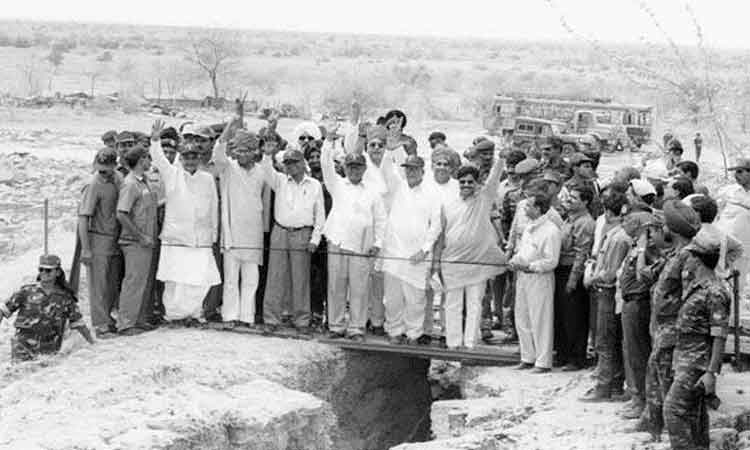
India’s first nuclear test in 1974 called smiling Buddha in Pokhran desert was, for tactical reasons, characterized as “Peaceful Nuclear Explosion”. The second series of five nuclear tests in 1998 (Pokhran II) was again accompanied by a statement from the then PM Vajpayee attesting to lack of aggressive intent. The 2003 Indian nuclear doctrine went a step forward and made a written unilateral concession about India’s adherence to “No First Use” Doctrine. Since then a lot of debate has gone into the rationale, the need and the necessity for India to revise her Nuclear Doctrine and posture. Some foreign policy mandarins have tried to argue that India does not need to make any changes in the 2003 version of the doctrine. Though the election manifesto of the BJP prior to May 2014 Lok Sabha election noted the need to take a relook at India’s nuclear doctrine, subsequent statements by the PM nipped it in the bud.

While looking at the nuclear scenario, India has to take the contemporary threat perception and other geo-political factors into account while revising her strategic nuclear policy. It will be a good idea for India to periodically revise her nuclear doctrine every 10-15 years based on the geo-political situation. A lot has already changed since 2003. There is nothing sacrosanct about revising a document that was essentially tactical in nature. Newer nuclear threats have emerged from both the nuclear neighbors, China and Pakistan that mandate that India revise her nuclear doctrine and posture in order to avoid future nuclear blackmail.

China has significantly diluted its “No first use” nuclear doctrine over the years. China has no intention of exercising restraint in the growth of its nuclear weapons program till the other two nuclear weapons superpowers (US and Russia) have brought down their number of nuclear weapons to China’s level. China has started deploying its nuclear powered submarines in the Indian Ocean region.

Pakistani Nuclear program was initiated in 1970s by ZA Bhutto after Pakistan’s defeat in Bangladesh war of independence in 1971. His famous statement in 1965 in UNSC was about waging a thousand years war against India. Later on he talked about eating grass and obtaining Nuclear weapons. Pakistan’s nuclear weapons program has been, is and will remain an India-centric nuclear toy in the hands of ISI/GHQ/Pakistani military as the civilians do not control the program. From the beginning Pakistani nuclear program has had Chinese footprints all over.
While Pakistan’s economy goes south, it remains a rentier state having extorted $31 billion from the US since 9/11. Pakistan keeps on getting tranches of money from the Kingdom of Saudi Arabia under an all-weather Sunni Alliance. Pakistan and ZA Bhutto had proudly proclaimed Pakistan’s nuclear weapons as “Islamic bomb” having been financed by Islamic money from KSA. Last year, Pakistani PM was able to obtain $ one billion from Saudi Arabia at a time when Pakistan’s economy took a hit. Money will never be a problem for Pakistani nuclear establishment as it grows at a disproportionate rate.

Pakistani ballistic missile program has also heavily borrowed from China and North Korea since the 1990s. Hatf IX (Vengeance-IV) Nasr was purpose built to carry tactical nuclear weapons (sub kiloton yield) over short range of 60-90 kilometers. On March 9 2015, Pakistan successfully tested the Shaheen-III surface-to-surface ballistic missile, capable of carrying nuclear warheads to a range of 2,750 km. Shaheen III nuclear capable missiles increase the range of Pakistani nuclear missiles to include the entire Indian land mass and the Indian Eastern naval command based in Andaman & Nicobar Islands. Pakistan has recently become the beneficiary of Chinese nuclear powered submarines that definitely pose a threat to India for her second strike capabilities.

General Khalid Kidwai who was the director of Pakistani Army’s Strategic Planning Division (SPD) for a period of 15 years, in an open meeting in March 2015 at the Carnegie Endowment for International Peace, in Washington DC aggressively articulated Pakistan’s new offensive nuclear doctrine and posture. He brazenly threatened India with the first use nuclear attack threats painting a new picture.  From the initial posture of credible minimum deterrence, Pakistan has moved to the concept of “Full Spectrum Deterrence” which envisages aggressive and offensive use of nuclear weapons by Pakistan against India in a number of scenarios. Not only Pakistan has linked its full spectrum nuclear deterrence doctrine with resolution of J&K dispute in its favor, Pakistan has threatened to use nuclear weapons against India if its tentacles in Afghanistan are cut off. Extra-territorial linkage with loss of its assets in Afghanistan widens the role for nuclear weapons under the new Pakistani doctrine.

Pakistan has already developed tactical nuclear weapons to be used in the war theater on the mechanized divisions of Indian armed forces. Ostensibly, Pakistan has justified use of tactical nuclear weapons as a policy against Indian Army’s imaginary “Cold start doctrine” which was never officially promulgated.

Pakistan is the only country that has single-handedly blocked an international agreement on FMCT while feverishly increasing its fissile material production. While traditionally cited figure is Pakistan has 90-110 nuclear weapons, reality has changed during last few years. The Pakistani nuclear armada is the fastest growing in the entire world with production of 10-20 new nuclear weapons every year.
Pakistani state has brazenly and repeatedly indulged in nuclear blackmail and rent collection over the last several decades. This Pakistani behavior will NOT change only the sponsors and the rent-payers will change over time.

There is NO reason for India to remain complacent while the nuclear threat perception changes. The PM will do a yeoman’s service to long-term strategic security of Indian nation if he revisits the Indian nuclear doctrine and allows it to grow some teeth. A number of remedial steps can be taken including discarding the meaningless no-first use doctrine to safe-guard nation’s security. Victors always write the history and India has lost repeatedly in history making.


Image Credits: pib.nic.in 


अपि स्वर्णमयी लङ्का न मे लक्ष्मण रोचते जननी जन्मभूमिश्च स्वर्गादपि गरीयसी

DR. ADITYANJEE
PRESIDENT, THE COUNCIL FOR STRATEGIC AFFAIRS, NEW DELHI
adityancsa@gmail.com
twitter@DrThinktank

Sunday, May 25, 2014

MR. PRIME MINISTER MODI, AWARD BHARAT RATNA TO ATAL


MR. PRIME MINISTER MODI, AWARD BHARAT RATNA TO ATAL

Independent India knows how to slight, insult and forget her historic icons! We did it with Netaji Subhash, Sardar Patel & Dr. BR. Ambedkar. We choose to call Bhagat Singh, Rajguru and Sukhdev as terrorists in government approved school textbooks while  some of our emancipated former leaders have glorified terrorists with  the  use honorifics like “Osamaji”.For the first time, there is a golden opportunity to correct the former wrongs into rights. Better late than never!

India has the reputation of being a lamb state whom anyone could punch without any probability of retaliation. That changed with India’s bold nuclear posture in 1998. The person who took that bold initiative has not been honored by the nation. While two former Prime ministers vainly awarded themselves Bharat Ratna, Atal Bihari Vajpayee was too modest to follow in their foot-steps. The UPA government had 10 years’ time to honor this former PM but they chose not to out of pettiness and partisan politics.The insult was further compounded by awarding Bharat Ratna to a nobody like Sachin Tendulkar. Of course in India cricket has become the opium of the masses. 

Mr. Prime Minister Modi, you have the golden chance to make history yet again by announcing Bharat Ratna for the former Prime Minister Atal Bihari Vajpayee, the man who transformed India from a fledgling lamb state to a confident nation on the road to superpower status. 

This leader deserves to be awarded Bharat Ratna before he leaves all of us on this planet. Let us not wait more or wait for another day! Certainly let us not make it a posthumous award as was done for Sardar Patel, JP Narayan, Gopinath Bordoloi & Dr. BR Ambedkar


अपि स्वर्णमयी लङ्का न मे लक्ष्मण रोचते जननी जन्मभूमिश्च स्वर्गादपि गरीयसी

DR. ADITYANJEE
PRESIDENT,
THE COUNCIL FOR STRATEGIC AFFAIRS, NEW DELHI
adityancsa@gmail.com
twitter@DrAdityan

Sunday, May 12, 2013

INVIGORATING IBSA; INVENTING IIBSAA


INVIGORATING IBSA; INVENTING IIBSAA

DR. ADITYANJEE

http://councilforstrategicaffairs.blogspot.com/2013/05/invigorating-ibsa-inventing-iibsaa.html

Introduction:

The post-mortem reports of the recently held 5th BRICS summit from March 26th-27th 2013 have already been written and forgotten. On June 6th 2013, India is hosting the next IBSA summit. As early as 2011, this analyst had predicted that China will try to kill IBSA (India, Brazil, South Africa) grouping by enlarging the BRIC to BRICS [1]. China cunningly brought in South Africa in the original BRIC grouping in 2011 though it did not belong to this economic dialogue forum. China had two-fold objectives: First and foremost to neutralize IBSA and second fold to gain entry into the African continent using South Africa as a staging post [2]. The original criteria for BRIC membership was the status of the four countries as emerging economies. Though these countries are very disparate and have their own separate agenda, the common anti-Western stance and emerging economy status were the two least common denominators [3]. China has indeed used the modified BRICS mechanism to make IBSA redundant and has become the de facto leader of BRICS [4]. BRICS has been described as an artificial grouping. Rajinder Puri, a senior columnist has stated very bluntly: “Neither strategic nor economic considerations justify the new grouping of Brazil, Russia, India and China. All four nations have vastly different priorities and concerns” [5]. Predictably South Africa led by President Zacob Zuma repaid the favor done by China while serving as a useful idiot for the Beijing and created dissonance in the BRICS with India feeling humiliated as the Indian PM was kept 40 kilometers away from the venue [6]. As Jaswant Singh rightly points out that Lamido Sanusi, the governor of Nigeria’s central bank, has called for Africans to recognize that“their romance with China” has helped to bring about “a new form of imperialism” [7]. Both Brazil and India are very wary of China’s mercantilist trade policies [8]. A cash-rich China is going to use its $ 3.4 trillion foreign exchange reserves to dominate the BRICS Development Bank and the BRICS Currency Reserve Arrangement (CRA).
In the Bandung Conference in 1955, both India and China sought to take the leadership of the developing countries. As the NAM or the group of 77 gradually evolved, China was relegated to the background owing to its own internal problems whereas India emerged as the clear leader of the NAM and the developing world leaving behind both Egypt and Indonesia. China had resented the towering personality and the leadership of Jawaharlal Nehru in the NAM. Now NAM is practically defunct and has lost its relevance though ritualistic and meaningless meetings still go on. In a sense BRICS had the potential to assume the collective leadership of the “Global South” in the 21stcentury when NAM had run out of steam.

The biggest USP of the IBSA summit is that IBSA is an outfit that is sought by the Chinese to be rendered infructuous after BRICS [9]. Incidentally, just like NAM, IBSA was facilitated into existence by another Indian Prime Minister Atal Bihari Vajpayee who met with his counter-parts in 2003 in Evian. The establishment of IBSA was announced on June 6th, 2003 by signing of “Brasilia Declaration” by the external affairs ministers of India, Brazil and South Africa. This “Brasilia declaration” mentions the democratic credentials of the three member nations, their status as developing countries, and their capacity of acting on a global scale as the main reasons for coming together as a grouping.

The Chinese checkmate to India in BRICS must be dealt with coolly with a focus on invigorating the IBSA mechanism .India must do the necessary ground work and home work so that the “enhanced” BRICS does not end up swallowing and eventually digesting the “IBSA” where India has been the prime mover [10]. We will discuss some of the historical antecedents and tactical responses that India can adopt to counter China while maintaining the leadership of the “Global South” in the international arena.

BRICS Versus IBSA

A detailed exposition on the differential roles and the relationship between IBSA and BRICS is dealt by Professor Arkhangelskyaya from the Russian Academy of Sciences; there are some areas of overlap between BRICS and IBSA especially in the constituent membership [11]. However, that alone does not justify disbanding of the IBSA because the defining characteristic of IBSA is south-south cooperation among the “developing democracies”. Some have erroneously suggested that the IBSA was the past having been started in 2004 and BRICS is the future [12]. The role of BRICS is very different from that of IBSA. It is essentially a counterweight to G7 in the global power politics. BRICS has been seen by many analysts as a step towards the evolution of a multipolar world order. This is true to an extent but BRICS has yet to prove its credentials [13]. Whether it will succeed in its role of counter-balancing the G7 will be very much a function of future Chinese international behavior. If China tries to dominate the group, except for South Africa, none of the other countries will tolerate Chinese quest for paramount leadership role under the BRICS framework. It is very unlikely that Russian Federation will serve as a junior partner of China for long. As the former external affairs minister Jaswant Singh emphasizes very succinctly: “BRICS’ shared potential does not translate into collaborative action. On the contrary, each of the BRICS will have to pursue its goals, and confront its challenges, individually [14].
Both Egypt and Indonesia are very keen to join the BRICS. Other potential applicants may include Turkey, Nigeria and Mexico. Future membership of the BRICS should be criteria based and not driven by Chinese or Russian strategic interests in order to avoid intra-group squabbles. Here one would agree with the Russian suggestion for freezing the BRICS membership for the next few years. Despite having overlapping memberships, the two can act as complimentary to each other. One major difference between the two fora is the two tiered power structure of BRICS in which two of its members are also permanent, veto wielding members of the UNSC [15]. As permanent members of the UNSC, neither Russia nor China is enthusiastic about the entry of Brazil, India or South Africa into the inner sanctorum [16]. These two, Russia and China are also members of the Shanghai Cooperation Organization (SCO), a quasi-security pact in Central Asia [17]. There are apprehensions that the SCO agenda of Russia and China may contaminate the functioning of BRICS. India’s participation in BRICS is being questioned as costly [18]. The relevance of South Africa’s membership is also debatable on economic grounds [19]. Such a differential economic power equation is not conducive to long-term harmonious functioning of BRICS. Harsh Pant hits the bull’s eye when he says: “The narrative surrounding the rise of BRICS is as exaggerated as that of decline for the US. The tectonic plates of global politics are certainly shifting, but their movements are unpredictable. BRICS will remain an artificial construct, merely an acronym coined by an investment banking analyst, for some time to come” [20].

Future of IBSA

Keeping in view the inadequacies of BRICS, India must remain determined to continue with IBSA as well. Over the years, IBSA has become an umbrella for various initiatives in the diplomatic and policy field, in Public Administration and inclusive developmental sectors. It is important to note that IBSA members do not have any geo-political or territorial conflicts but that is not true of BRICS. Both India and China do have a border conflict which has not been resolved. Similarly, both China and Russia share an extensive land border and do have some territorial and geo-political issues. There is latent competition between Russia and China for dominance in Central Asia although both would like to see the US dominance in global affairs reduced. The degree to which a shadow of BRICS will fall on IBSA seems to be very dependent on the weakest link, South Africa, which is “sitting on two chairs” [21]. The signature issue for the IBSA identified in the “Brasilia Declaration” was south-south cooperation for the “developing democracies”. Despite what happened in Durban, South Africa, the IBSA remains a good forum for the “developing democracies”. A resurgent India must learn to be proactive and not reactive in execution of her foreign policy.

Inventing IBSAA

India must take the leader-ship to enlarge the “IBSA” into “IIBSAA” (India, Indonesia, Brazil, South Africa & Argentina) in order to make this block of developing democracies more relevant in the international fora. This would require two other “developing democracies”, namely Indonesia and Argentina to be invited to join the “IBSA”. Both China and Russia are not true democracies at this time and do not deserve a seat on the enlarged “IIBSAA” forum. The China angle would be important in the enlarged IIBSAA by virtue of its absence! Though Egypt is interested in joining BRICS and may be interested in joining IIBSAA also, it is not a fully evolved democracy as yet. More democratic reforms would be needed before Egypt can qualify for the status of “developing democracy”. After inviting Indonesia and Argentina, the membership should be frozen for the next five years while criteria for membership are agreed upon and the organization evolves in a credible manner. India should finalize a formal charter for the enlarged IIBSAA and minimum criteria for future membership applications.

Building a Permanent Secretariat

Without a permanent executive secretariat, any international organization is likely to wither away as we have learnt from the NAM experience. India must offer her facilities to host a permanent executive secretariat for the enlarged IIBSAA forum in New Delhi. Perhaps, the MEA sponsored think tank like ICWA can serve as the temporary facility while new office space is located and infra-structure is built. Besides rotating presidency for two years there must a permanent executive secretary general appointed for a period of not less five years to provide continuity in policy otherwise the agenda seems to change with every rotating presidency. No person should be allowed more than two terms as secretary general of the IIBSAA. IIBSAA members should coordinate their voting patterns in the UN General Assembly and the UNSC whenever possible. It should be the responsibility of the Secretary General to coordinate the various viewpoints and arrive at a consensus of the “developing democracies”.

IIBSAA Fund

The original IBSA mechanism had a puny corpus of three million dollars per year contributed equally by each of the three countries. The fund is managed by the UNDP and focuses on projects on poverty alleviation. This needs to be increased sequentially so that lack of funds to do not handicap this important forum. Perhaps, the newly enlarged group should aim for a corpus of $ one billion per year with each country contributing $ 200 million. This Fund for poverty alleviation and inclusive growth should not be considered as a challenge or alternative to the BRICS Development Bank which will be used only for infra-structure needs.

IIBSAA FTASA

At a time when free trade areas are becoming the norm, the developing democracies should negotiate a “free trade and services area” among the member nations. Both the CII (Confederation of India Industries) and the FICCI (Federation of Indian Chambers of Commerce and Industry) should be encouraged to establish an IIBSAA Business Council.

IIBSAA Maritime Dialogue

Since all these five nations are sea-fairing nations with long coast lines, naval and maritime cooperation should be beefed up. Joint anti-piracy efforts in a coordinated manner in the Indian Ocean and Arabian Sea while securing sea lanes of commerce should be a priority. Providing naval refueling and docking facilities to merchant ships and naval assets of member nations needs to be formalized by agreement.

IIBSAA Counter-Terrorism Efforts

An enhanced IIBSAA should focus on intelligence gathering across various continents to deal with the scourge of terrorism. As terror organizations have global reach and utilize lax laws in developing countries, perhaps common strategies for counter-terrorism efforts would be a new area for cooperation among the IIBSAA countries.

Human Rights Focus

Since all the three current members are multi-racial, multi-religious and multi-ethnic democracies focusing on inclusive growth and poverty alleviation, the group needs to take consistent viewpoint on human rights internationally [22]. On the issue of human rights other members of the BRICS mainly China and Russia have to improve their records before they can become candidates for this group. The group has to deal with Western Countries so that the R2P doctrine is not misused internationally against developing democracies while furthering the Western agenda [23]. This group can provide advice and material help to other developing democracies in improving their human rights records and performances on their own without being scrutinized by the West, thereby avoiding intrusive external interventions.

Delivering Democratic Dividend

The fruits of inclusive growth must be delivered to the masses within the boundaries of each of the member nation in a fair and equitable manner. That is the democracy dividend that members of the enlarged IIBSAA must try to gift their citizens and to citizens of the rest of the world. This aim alone would make for the very existence and the raison d’etre of this important dialogue forum.


DR. ADITYANJEE
PRESIDENT,
THE COUNCIL FOR STRATEGIC AFFAIRS,  NEW DELHI 
 adityancsa@gmail.com
twitter@adityanjee

  1. 1. Adityanjee: Invading the strategic space: the Dragon fires another salvo at India,
  2. Ibid
  3. Adityanjee: Securitisation of the BRICS
  4. Ibid
  5. Rajinder Puri : Building China Brick by BRIC!
  6.  Indian Express  
  7.  Jaswant Singh: Crumbling BRICS,
  8.  Shyam Saran: BRICS and premature orbituaries,
  9.  Rajeev Sharma: Natural partners: Why India needs to get closer to Japan,
  10.  Op cit Adityanjee, #3
  11. Arkhangelskaya, Alexandra A: IBSA-past? BRICS-Future?
  12.  Ibid
  13.  Arvind Gupta: BRICS comes of age at Durban
  14.  Op cit Jaswant Singh (#7)
  15.  Op cit Adityanjee (#3)
  16.  Op cit Shyam sharan (#8)
  17.  Adityanjee (#3)
  18.  Rajiv Kumar; BRICS: India’s costly time-pass.
  19.  Roy Robins: One of the BRICS is not like the others.
  20.  Harsh Pant: BRICS Nothing But a Chinese Front Group.
  21.  Op cit Arkhangelskaya, Alexandra A (#11)
  22.  G Ananthapadmanabhan and Atila Roque: India and Brazil: Time for a New Human Rights Partnership.
  23.  ibid